Youth and its transience
First LoveYouth and its transience is the central contrast in Vladimir Petrovitch’s account of his first love: at sixteen, life seems to open toward limitless possibility, while the older narrator looks back on that confidence from a life already moving into evening. The theme gathers force through the distance between the boy’s expectation and the adult’s knowledge, and through the deaths that finally test the young self’s conviction that sorrow can be turned to pleasure.
The young narrator’s season of expectation
Vladimir Petrovitch’s memory begins in the summer of 1833, when he is sixteen and living with his parents near Moscow. His family has left the city for a country house facing the Neskutchny Gardens. He is preparing for the university, but studies without urgency; after his French tutor has gone, no one closely regulates his days. The loose structure of this summer matters: youth first appears as freedom from pressure, a time that seems to offer more possible futures than immediate obligations.
The recollection makes that freedom felt through a succession of habits and moods. Vladimir Petrovitch walks in the family garden, through the Neskutchny Gardens, and beyond the town gates, carrying a book such as Keidanov’s Course but rarely reading it. More often he recites poetry aloud. He rides alone, saddles his own horse, gallops, and imagines himself a knight at a tournament. These details show a mind turning ordinary activities into rehearsals for a larger, imagined life: the book is present but neglected, while verse and fantasy take possession of his attention.
His emotional life is equally expansive and unformed. He is hopeful and expectant, yet also frightened of something he cannot name; he dreams, grows sad, and sometimes weeps. A verse or the beauty of evening can lift him again into what the recollection describes as the sense of youth and effervescent life. The shifts between sadness and exhilaration do not cancel each other. They belong to a season in which feeling itself seems inexhaustible, and even melancholy can coexist with the belief that life is opening rather than closing.
Love has not yet taken a definite shape in his thoughts. Instead, Vladimir Petrovitch recalls a half-conscious presentiment of something new, sweet, and feminine. The distinction is important: the boy does not begin with a clear understanding of what awaits him. His later first love enters a life already charged with expectation, but the feeling precedes the person who will give it a form. In retrospect, youthful openness appears both genuine and limited: he senses an approaching change without being able to know its course.
Retrospective distance and the cost of possibility
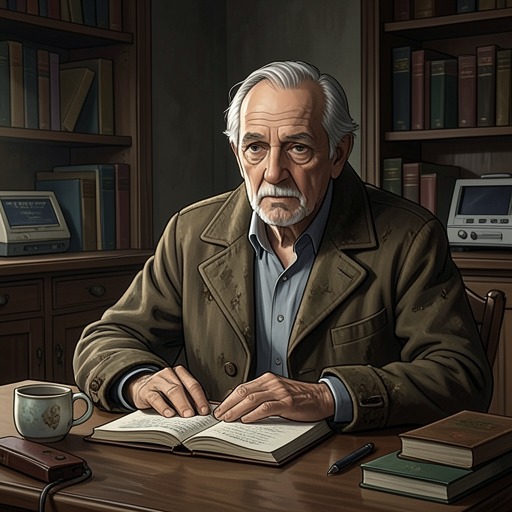
The story’s presentation makes the gap between experience and understanding part of the theme. In the opening frame, the party has ended and the clock has struck half-past twelve when Vladimir Petrovitch is asked to tell about his first love. He resists telling it aloud, saying that his efforts at storytelling become either dry and brief or overextended and affected. Instead, he offers to write down what he remembers; his friends meet again a fortnight later, and he reads the resulting manuscript. The remembered summer therefore reaches the reader through an older man’s deliberate act of recollection, not as an unmediated record of what the boy understood at the time.
That adult perspective becomes explicit after Vladimir Petrovitch learns that Zinaïda has died. Meidanov gives him her address at the Hotel Demut, where she is staying under the name Madame Dolsky. Vladimir Petrovitch means to visit, but business intervenes; a week passes, then another. When he finally goes, he learns that she died almost suddenly in childbirth four days earlier. The fact that he might have seen her but did not turns youthful memory into a source of reproach: the past rises before him, yet the lost opportunity cannot be recovered by remembering it.
His reflection broadens from this particular loss into an account of youth’s confidence. Youth, he says, seems master of the universe’s treasures and able to make even sorrow serve its pleasure. It imagines itself uniquely alive, while its days continue to pass and vanish. The image of wax in the sun and snow disappearing gives that passage a material finality: what once seemed abundant and self-renewing can melt away without leaving the future the young self expected. The reflection does not simply condemn youthful confidence. It identifies its charm in the feeling that one might do anything, and in the wasteful expenditure of forces whose later use cannot be known in advance.
Sorrow, memory, and what remains
The older narrator does not treat the memory of youth as a simple story of lost happiness. He asks what became of the rich future he once foresaw, and what remains fresher and more precious as the shades of evening begin to fall over his life. His answer is not that youthful hopes came true. Rather, the remembered storm of early morning and spring survives as a precious experience precisely because it was brief. Memory preserves the intensity of expectation even when it cannot restore the opportunities that expectation seemed to promise.
A second death complicates any claim that youth can turn every grief to its own advantage. A few days after hearing of Zinaïda’s death, Vladimir Petrovitch is present when a poor old woman in the same house dies. She has lived amid daily want, known no joy, and endured a painful death. Until her strength fails, she crosses herself and whispers a prayer for forgiveness; fear of the end remains visible until consciousness disappears. At this deathbed, Vladimir Petrovitch feels aghast for Zinaïda and longs to pray for her, for his father, and for himself. The encounter draws attention away from youthful self-absorption toward mortality shared across very different lives, without suggesting that their circumstances or experiences are alike.
The closing return to youth is therefore both tender and chastening. The young Vladimir Petrovitch could regard sorrow as something that might enrich him; the older narrator knows that a missed visit and a death cannot be undone by the feeling they leave behind. Yet the memories retain their power. The first love’s phantom calls forth only a sigh and a mournful sentiment, but the narrator continues to measure the present against the springtime of his early life. Youth’s transience is not merely the fact that time passes. It is the painful difference between imagining a future without limit and discovering, through loss and recollection, what that future did—and did not—contain.